
Costa Rica might not be the first destination that comes to mind when you think of a bikepacking trip.
Yet, the day Adriano shared the idea for the 2025 destination, curiosity turned into enthusiasm, and enthusiasm into possibility.
We were looking for a place that was more than just a route to ride: we wanted an experience that would continue even once we got off the bike. A place capable of giving us the full flavor of a journey made of sea, nature, and exploration.
It’s a safe country, where people welcome you with a smile, tap water is drinkable almost everywhere, and the tourist infrastructure is so well organized that traveling is easy—even when you’re moving on two wheels loaded with bags.
November, as has been the case for a few years now, is that moment of the year when commitments fall perfectly into place and make room for departure. After Scotland, Istria, Rwanda, and Morocco, we’re once again ready to board a plane. Destination: San José.

Costa Rica is famous for its biodiversity and for the political stability that makes it a peaceful oasis in the heart of Central America. But beyond the face everyone knows, it’s also a land that seems tailor-made for bikepacking. Sure, its sun-kissed beaches, perfect surf waves, and rainforest trails are no secret to gringos: every winter, thousands of American tourists flee the cold to take refuge in this green paradise. And yet, the bicycle offers a different perspective. Where crowds of visitors stop, bikepacking continues. Costa Rica, experienced from the saddle, reveals itself in all its authenticity: wild and unspoiled.
Part of the fun of our bikepacking trips lies precisely in leaving room for improvisation—deciding things on the go, following instinct rather than a rigid plan. The initial idea, however, was simple: leave San José heading toward Puntarenas, take the ferry, and reach Paquera. From there on, the route climbs north through a humid, rural countryside, immersed in tropical forest, with stretches of hard-packed beach suddenly opening up, and river crossings and fords to be tackled several times a day, bike on our shoulders.
This is the Nicoya Peninsula, a special place. It has been recognized as one of the world’s famous Blue Zones, where an unusually high number of centenarians live. A land where time flows more slowly—or perhaps simply better.
The route also passes through some more touristy towns, such as Sámara, Santa Teresa, and Tamarindo, small hubs where the flow of travelers increases and tranquility gives way to a livelier energy. But these are only brief interludes: for most of the journey, the road runs far from crowded places, offering long stretches where nature reigns supreme.
It’s not an easy route. Rough roads, brutal climbs, and humidity that wraps around everything make this a demanding ride. This is not a place for effortless “hundreds” each day—here, every kilometer must be earned. The dirt roads along the Nicoya coast are known for being rugged and far from smooth, but the chance to end the day on one of the many beaches, watching the sun set behind the Pacific, was one of the main reasons we chose Costa Rica.
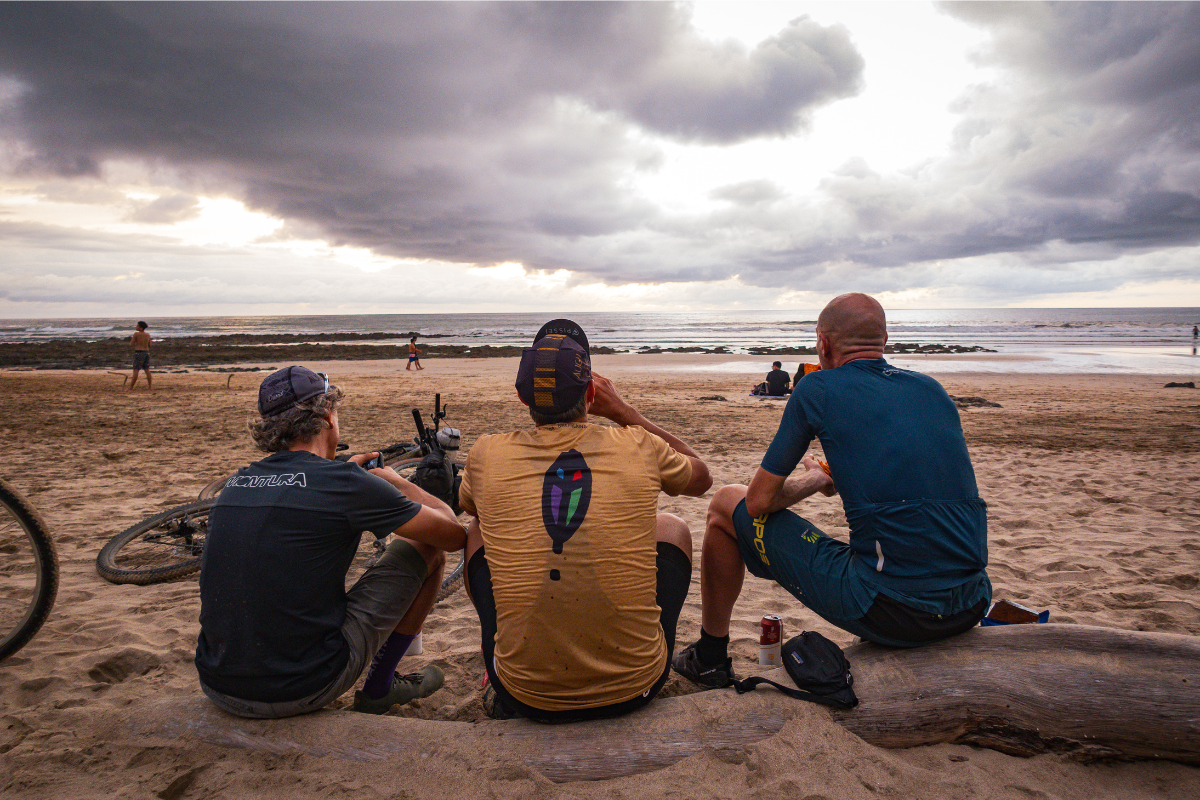


We rode for days in humidity so intense it took our breath away. And often, without any warning, the sky would open up: you’d be pedaling under a hot sun and, a moment later, a huge raindrop would hit you straight in the eye. You’d look up and realize it was already too late.
Once we reached Tamarindo, famous for its surf spots, we decided to stop for a day. The waves here are reliable, and while they grow more powerful further offshore, near the beach they break softly and regularly—perfect for both experienced surfers and beginners. Along the shoreline, wooden shacks offer rentals and lessons, and it was impossible to resist the temptation to give it a try.

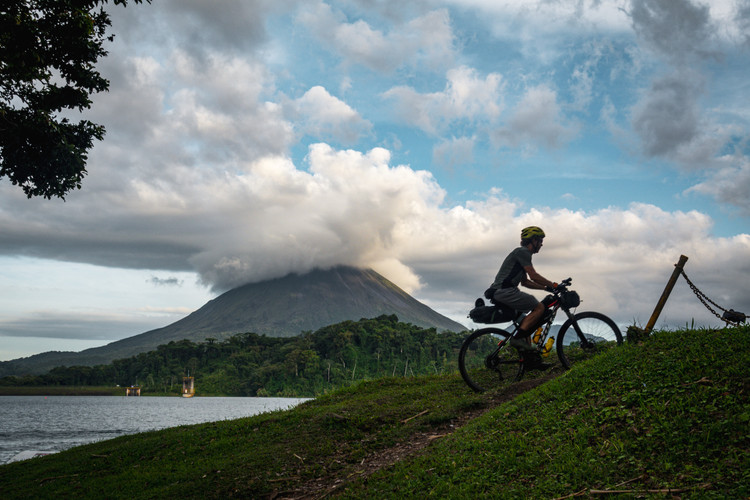
The following day, we took a taxi shuttle to reach the shores of Lake Arenal: the road connecting Tamarindo to the lake is not safe to ride by bike due to heavy traffic. Around the lake, however, the roads are calm and pleasant to pedal, with the skyline dominated by the imposing triangular silhouette of Arenal Volcano all the way to the town of La Fortuna.
When we reached National Route 4, the atmosphere changed. For a few kilometers, traffic became intense, almost clashing with the calm we had grown used to. But there was no alternative: it was the only way to reach La Pavona, the gateway to a completely different world. From here, lanchas depart and wind their way through the jungle for 18 kilometers. The river narrows, vegetation closes in like a green cathedral. This is how you enter Tortuguero National Park: by navigating, letting yourself be swallowed by the forest.
Tortuguero is one of Costa Rica’s richest parks in terms of biodiversity. It is almost isolated from the rest of the country: the Caribbean Sea protects it to the east, the border with Nicaragua lies to the north, and impenetrable rainforest stretches to the west. For this reason, it can only be reached by river or by air, landing in a small clearing carved out of the jungle. And yet, perhaps because of this remote allure, it is one of the most visited parks in the country. Covered almost entirely by rainforest, Tortuguero is home to thousands of species of birds, reptiles, and other wildlife. In Spanish, tortuguero means “place of turtles”: its protected beach is in fact one of the most spectacular places in the world to witness sea turtles nesting.
We spent two nights in the village and organized a kayaking trip along the jungle canals. Our guide, with great skill, pointed out monkeys camouflaged among the branches, caimans motionless in the water, toucans, and birds in impossible colors. Seated in our kayaks, we kept turning our heads in every direction, trying to capture every fragment of that forest teeming with life. It was magnificent. Costa Rica Pura Vida, meaning “a whole lot of life”: in just two words, it captures the entire lifestyle of the country. And the more you repeat it—because there are many occasions to say it every day—the more you start to believe it.
"COSTA RICA Pura Vida siempre con nosotros"
- Umbria Bikepacking -
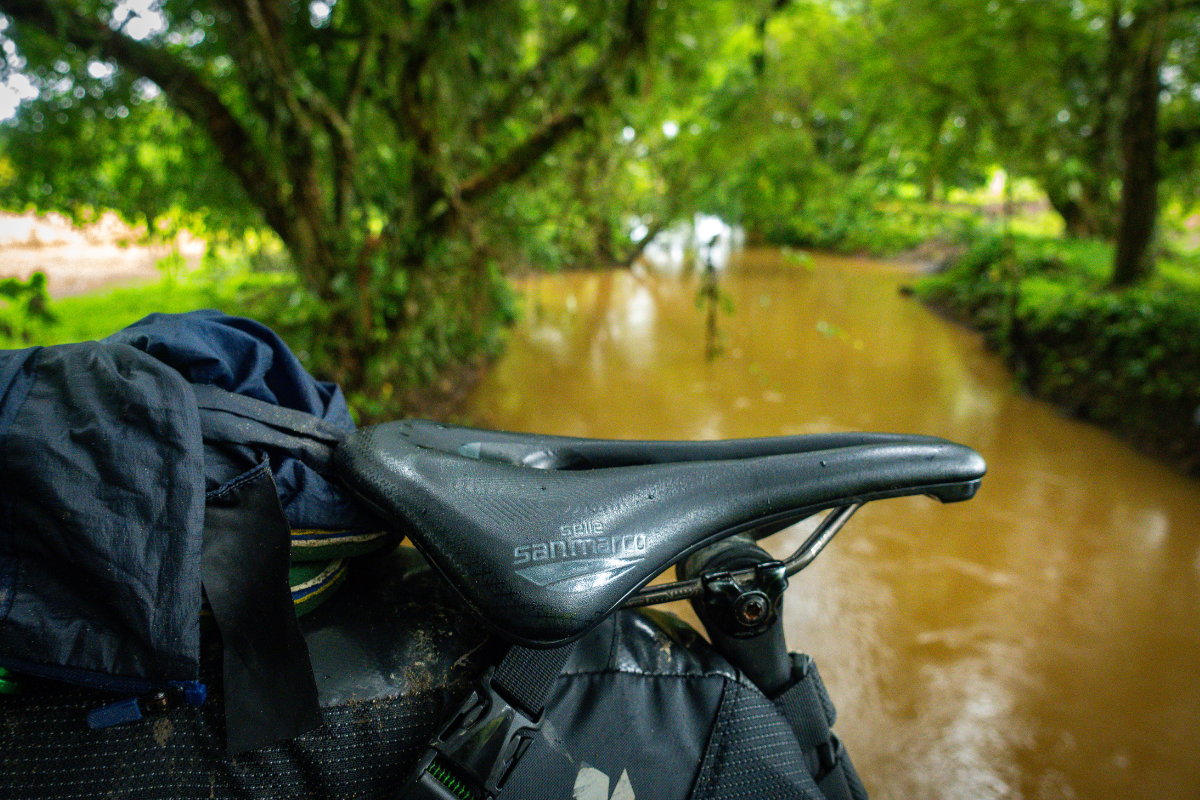
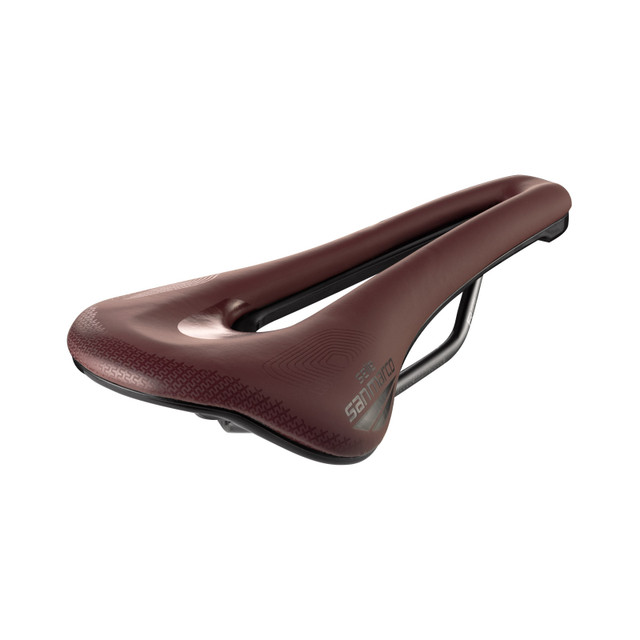
Shortfit 2.0 Supercomfort Racing

Aspide Short Supercomfort Racing

Allroad Supercomfort Racing
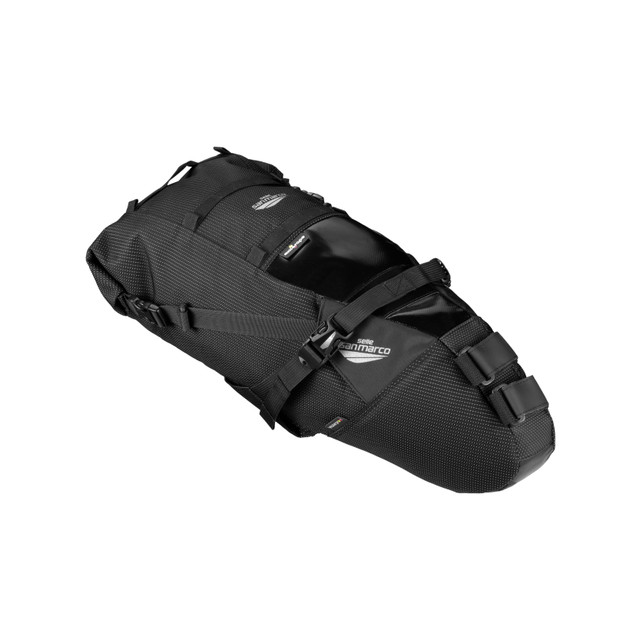
Saddle Bag 13 L

Frame Bag 6 L

Presa Corsa Comfort